You Know You’re a Fascist When You Believe the Following:
Are you a fascist and how would you know? The concept of freedom is often heralded in political discourse, yet this very notion can be paradoxically entangled with oppression.
DEMOCRACYFREE SPEECHEDUCATIONCOURTS

The Paradox of Freedom and Oppression
Are you a fascist and how would you know? The concept of freedom is often heralded in political discourse, yet this very notion can be paradoxically entangled with oppression. Individuals and groups may vocally advocate for liberties, all the while endorsing policies that fundamentally undermine the rights of others. This incongruity frequently emerges in contemporary discussions surrounding immigration and national security, where calls for "freedom" coexist with support for mass deportations without due process. Such policies, ostensibly aimed at protecting national interests, may actually serve to strip individuals of their basic human rights, raising critical questions about the true meaning of freedom in these contexts.
This contradiction can be examined through the lens of cognitive dissonance, a psychological phenomenon where individuals experience discomfort due to holding conflicting beliefs or attitudes. For example, one might believe in the inherent dignity of all individuals and yet support stringent immigration policies that lead to the expulsion of vulnerable populations. This internal conflict can drive individuals to rationalize their beliefs, often diminishing their empathy for those affected by oppressive measures. As a result, one may observe a disconnection between one’s professed values of liberty and the societal actions they endorse, creating a facade of moral righteousness while simultaneously propagating forms of authoritarianism.
The Assault on Education and Intellectual Freedom
The escalating trend of banning books and undermining educational institutions is a critical issue that cannot be overlooked in contemporary society. The implications of these actions extend far beyond the confines of school walls; they signal a broader assault on intellectual freedom and critical thought, foundational elements of a vibrant democracy. Censorship not only limits access to diverse viewpoints but also stifles the ability of individuals to engage in meaningful discourse, thereby hindering the development of critical thinking skills.
Historically, when regimes have pursued the path of intellectual oppression, the consequences have been dire. For example, during the Nazi regime in Germany, the infamous book burnings epitomized the lengths to which authoritarian governments will go to suppress dissent and control the narrative. Similarly, the McCarthy era in the United States saw numerous individuals ostracized and many works vilified due purely to perceived ideological discrepancies. Such historical moments serve as poignant reminders of the dangers inherent in restricting academic freedom and knowledge dissemination.
The current attempts to gut universities and impose a narrow vision of acceptable education reflect an alarming disregard for the value of an educated populace. Education equips individuals with the tools necessary to analyze information critically and cultivate informed opinions. When these tools are systematically undermined through censorship, society risks producing generations ill-prepared to tackle complex challenges or engage thoughtfully in civic matters. The ramifications of an uneducated or misinformed citizenry are profound, leading to the erosion of democratic values and the rise of populistic ideologies.
In fostering ignorance, society creates an environment where misinformation thrives. This not only poses challenges to democratic governance but also erodes trust in institutions. Therefore, it is imperative to reaffirm the importance of unimpeded access to literature and robust educational frameworks to maintain a society that values intellectual freedom and critical thought.
Loyalty to Leaders Verses Loyalty to the Constitution
Loyalty, a cornerstone of governance and military conduct, becomes particularly complex when distinguishing between allegiance to individuals in power and commitment to foundational legal frameworks like the Constitution. In many political systems, especially those showing authoritarian tendencies, there exists a prevailing culture where military officials and public servants are expected to exhibit unwavering loyalty to their leaders, often at the expense of their duty to uphold constitutional principles. This shift raises significant ethical and operational concerns, fundamentally altering the dynamics of governance.
Historically, various regimes illustrate the hazards of prioritizing loyalty to a leader over the Constitution. For instance, during the rise of fascist governments throughout the 20th century, military and civilian institutions often succumbed to the demands of the individual in power, leading to systematic abuses of authority and the erosion of democratic values. The expectation of personal loyalty can create an environment where dissent is stifled, and critical checks and balances are weakened. In these contexts, adherence to a leader instead of the rule of law can facilitate the creation of authoritarian regimes that operate with impunity, prioritizing power over justice.
The implications for democracy are profound, particularly as we observe subtle shifts in political cultures worldwide. If military and political leaders continue to move towards personal loyalties rather than public accountability to the Constitution, the integrity of democratic institutions is at severe risk. Such loyalty dynamics could usher in an era of governance dominated by autocratic rule, where the foundational principles of democratic engagement are overshadowed by the singular charisma of a leader. Understanding the critical balance between loyalty to leaders and loyalty to the Constitution is essential for safeguarding democratic ideals and principles in contemporary governance.
The Hypocrisy of Law and Order
The concept of 'law and order' is often wielded as a political tool, selectively emphasized by leaders to highlight a commitment to societal stability. However, when this demand is applied unevenly, it exposes a profound hypocrisy that undermines trust in legal systems and exacerbates societal divisions. This duality becomes particularly evident when law enforcement actions or judicial decisions appear to favor political allies while punitive measures are strictly enforced against opponents. Such practices suggest a troubling narrative where the justice system is manipulated to serve particular interests, raising questions about the integrity of governance.
In today’s political climate, the call for unequivocal adherence to law can be hollow when those making demands fail to acknowledge, or even condone, illegal actions perpetrated by their allies. This selective scrutiny not only diminishes the credibility of legal institutions but also cultivates a perception of bias among the populace. Citizens are left to navigate a landscape where adherence to the rule of law is conditional upon political allegiance, leading to a deterioration in public trust and exacerbating polarization.
Electoral Processes
Furthermore, during electoral processes, instances of perceived election manipulation further complicate the discourse surrounding law and order. Allegations of tampering or intimidation during voting can invoke feelings of disenfranchisement among voters, particularly when the authorities, who are expected to protect democratic processes, appear to turn a blind eye to these violations. This perception of electoral irregularities compounds the disillusionment with the judiciary’s impartiality, directly impacting the core of democratic integrity.
Thus, the hypocrisy surrounding 'law and order' not only prompts vigorous debates among political factions but also serves as a reminder of the fragility of public trust. A judiciary that seems influenced by political pressures undermines the very foundations of democracy, reinforcing the necessity for a system that applies the law equally to all, irrespective of political affiliations.
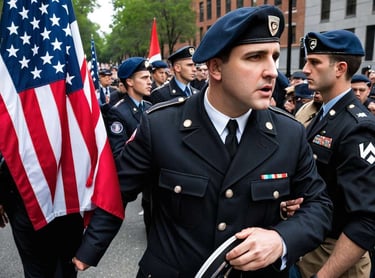
AI Generated Image
trumpianinsanity.com © 2023-2025 All Rights Reserved
Trumpian Insanity empowers people with the knowledge and tools to participate in meaningful political discourse and contribute to positive change.
Reframe your inbox
Subscribe to my blog and never miss a story.
We care about your data in our privacy policy.