When Entitlement Becomes a Movement: The Assignment That Became a Culture War
At the University of Oklahoma, a straightforward psychology assignment—analyzing how society understands gender using empirical research—somehow detonated into the right’s latest culture-war bonfire.
EDUCATIONPOLITICSCULTUREMEDIA
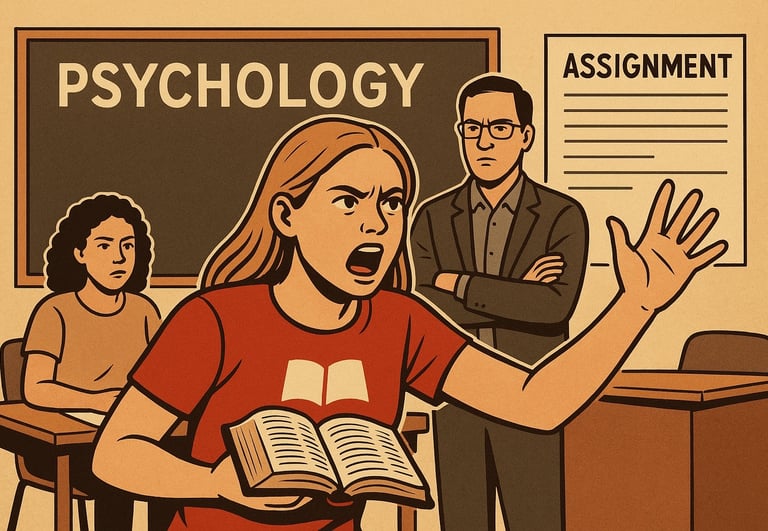
At the University of Oklahoma, a straightforward psychology assignment—analyzing how society understands gender using empirical research—somehow detonated into the right’s latest culture-war bonfire. And all because one student, Samantha Fulnecky, decided that actually doing the assignment was optional if she felt strongly enough about her own beliefs.
Instead of analyzing the article she was given, she turned in a sermon drenched in Bible verses, declared the concept of multiple genders “demonic,” and then cried “religious discrimination” when she earned the grade anyone else would’ve received for ignoring the instructions: a zero.
In a sane world, this would be the end of the story. But we don’t live in a sane world anymore—we live in a world where entitlement masquerades as persecution and where a bad grade can be spun into a national morality play.
So let’s talk about where this entitlement comes from—and why it keeps erupting in public like a bad rash.
The New Rule: Your Beliefs Override Everything
There used to be a shared understanding in education:
Assignments have criteria.
Classes have standards.
Opinions don’t replace evidence.
Not anymore.
We now have a growing group of people who sincerely believe their personal convictions should outrank the expectations everyone else is held to. If an assignment requires research, they think beliefs are just as valid. If a class requires analysis, they think feelings count as data. If a discipline requires rigor, they think invoking God makes them immune to the rubric.
This is how you get someone turning in a religious rebuke to a psychology question and fully expecting an A for the effort.
Because in their worldview, consensus reality is optional.
The “Persecution Card” Has Become the New Participation Trophy
There’s no political tool more effective—or more cynically deployed—than shouting religious discrimination the moment accountability enters the room.
Not because discrimination actually happened.
But because the accusation itself is the point.
The playbook is simple:
Ignore the assignment.
Turn in whatever matches your worldview.
Receive the grade your work earned.
Declare yourself a victim of oppression.
Let the outrage ecosystem take it from there.
This strategy works because it taps into a ready-made narrative: the righteous conservative student being “silenced” by the “woke” academy. Even when the facts tell a much more boring truth:
She didn’t follow the assignment. She got a zero. Period.
Victimhood is now a brand, and some people are desperate to build a platform by wearing it like a varsity jacket.
Feelings ≠ Facts (Especially in Psychology Class)
You would think that in a discipline built on research, data, and scientific analysis, students would expect… well… research, data, and scientific analysis.
But in this new era, many people have been trained to believe that:
Their personal beliefs are empirical evidence
Their discomfort is an argument
Their worldview is universal truth
Their interpretation of scripture is a science textbook
This isn’t just entitlement—it’s epistemological chaos. It’s the belief that reality itself must rearrange to fit your doctrine.
It’s how someone can sincerely claim that referencing peer-reviewed research is “demonic,” while turning in a sermon to a psychology assignment is “academic integrity.”
Entitlement Taught, Fed, and Amplified
No one becomes this entitled on their own. They’re coached into it by:
Politicians who need outrage to stay relevant
Media personalities who profit from grievance
Pastors who preach persecution as a form of identity
Influencers who treat victimhood as a marketing strategy
These systems don’t just allow entitlement—they manufacture it.
People are taught that:
They should never be challenged.
They should never adapt.
They should never be held to secular standards.
They should never have to coexist with people who are different.
And when reality inevitably pushes back, they’re told that’s “oppression,” not consequence.
Entitlement becomes self-perpetuating.
It becomes a shield.
It becomes the entire point.
The Loudest “Anti-Snowflakes” Are the Most Fragile
There’s something especially rich about the crowd that endlessly screams about liberals being “snowflakes” turning around and collapsing into performative agony the moment they don’t get exactly what they want.
Miss an assignment? Oppression.
Face a consequence? Persecution.
Have rules applied equally? Tyranny.
Receive a zero for ignoring empirical requirements? A national crisis.
It’s the same pattern every time:
They want the freedom to ignore the rules, and the protection from ever facing the results.
That’s not belief.
That’s not faith.
That’s not courage.
That’s entitlement dressed in holy language.
The Core Question: Where Do People Get This Level of Audacity?
From a system that has taught them, relentlessly, that:
Rules are for other people.
Standards are optional if you’re religious.
Academia must bend to your worldview.
Discomfort is discrimination.
Accountability is persecution.
Facts are negotiable.
Being challenged is a threat.
They aren’t entitled by accident.
They’re entitled because a movement needs them to be entitled.
Entitlement fuels the outrage economy.
Outrage fuels political identity.
Political identity fuels power.
And so here we are: a simple assignment turned into the latest front in a never-ending culture war, all because one student believed her worldview should override the entire discipline of psychology.
It's Not About One Student, It's About a Culture
This story isn’t about one student and one grade.
It’s about a culture that has elevated fragility into a virtue, ignorance into defiance, and entitlement into a political identity.
It’s about people who genuinely believe they are so special, so righteous, so protected by ideology, that they should never have to be wrong, never have to adjust, never have to follow instructions, and never have to live in the same reality as the rest of us.
And when they’re told “you didn’t meet the criteria,” they don’t learn—they lash out.
Because entitlement, once rewarded, becomes a performance.
And once it becomes a performance, it becomes a weapon.
AI Generated Image
trumpianinsanity.com © 2023-2025 All Rights Reserved
Trumpian Insanity empowers people with the knowledge and tools to participate in meaningful political discourse and contribute to positive change.
Reframe your inbox
Subscribe to my blog and never miss a story.
We care about your data in our privacy policy.