When Emergency Becomes Excuse
“If you allow the government to break the law because of an emergency, they will always create an emergency to break the law.” This is not a slogan. It’s a law of political gravity
TRUMPDEMOCRACYPOLITICS
The Peril of Exceptionalism
“If you allow the government to break the law because of an emergency, they will always create an emergency to break the law.”
This is not a slogan. It’s a law of political gravity — the slow, inevitable pull toward authoritarianism once a government learns it can get away with it.
History is littered with examples of leaders who exploited fear and crisis to expand their power. In times of panic, the public’s instinct is often to seek security at any cost, even if that cost is liberty. And every government, no matter how democratic it claims to be, is tempted to use that fear to justify extraordinary measures.
The Pattern of Manufactured Crisis
Authoritarianism rarely begins with tanks in the streets. It begins with an “emergency.” A threat — real or exaggerated — becomes the rationale for suspending norms and bending laws.
The Roman Republic appointed dictators for short “emergency” terms, a system that worked until Julius Caesar decided not to give the power back. Hitler’s rise was cemented not in open warfare but through the Reichstag Fire — an act blamed on enemies of the state that allowed him to suspend civil liberties indefinitely.
Even in modern democracies, we’ve seen governments use terrorism, pandemics, and social unrest as justification to spy, detain, and censor far beyond what the law once allowed.
When Fear Becomes a Tool
Fear is the ultimate political weapon. Once a government discovers it can justify anything by invoking it — surveillance, censorship, detention, propaganda — there’s no reason to stop.
What begins as a “temporary measure” morphs into permanent policy. Emergency powers become normalized, then institutionalized, and soon the people forget that these powers were ever extraordinary at all.
It is no coincidence that the longest-lasting states of emergency in the world belong to regimes that are least democratic. The same justification — we must protect the nation — becomes the eternal refrain for eroding the very freedoms that define it.
The Modern Echo
In the United States today, the language of “emergency” has crept into the political bloodstream. “National emergency” declarations have been used to bypass Congress. Governors and presidents alike have learned that, in moments of fear, the public is pliable.
Whether the threat is immigration, terrorism, disease, or protest, there is always another crisis ready to be exploited. And each time we allow it — each time we say, “Well, this time it’s different” — we inch closer to a government that no longer needs an excuse.
The Only True Emergency
The real emergency is not the crisis outside our doors, but the erosion of law and accountability inside the halls of power.
When the rule of law bends in the name of safety, democracy fractures in the name of stability, and the Constitution is treated as optional when it’s inconvenient, then the emergency has already arrived — and it is us who have allowed it.
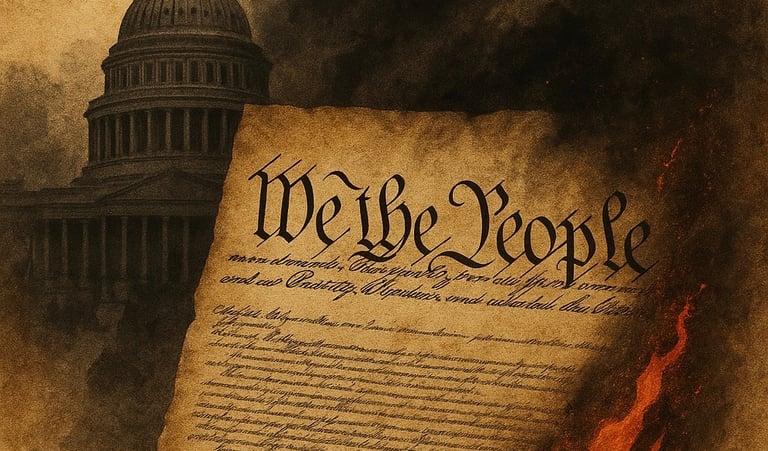
AI Generated Image
trumpianinsanity.com © 2023-2025 All Rights Reserved
Trumpian Insanity empowers people with the knowledge and tools to participate in meaningful political discourse and contribute to positive change.
Reframe your inbox
Subscribe to my blog and never miss a story.
We care about your data in our privacy policy.