When a President Declares Half the Country the Enemy
When Donald Trump labels nearly half of Americans as the “greatest enemy,” second only to a foreign adversary like Iran, it marks a dangerous turning point. A president is supposed to unify. This does the opposite.
DEMOCRATSDEMOCRACYELECTIONSTRUMPPOLITICS
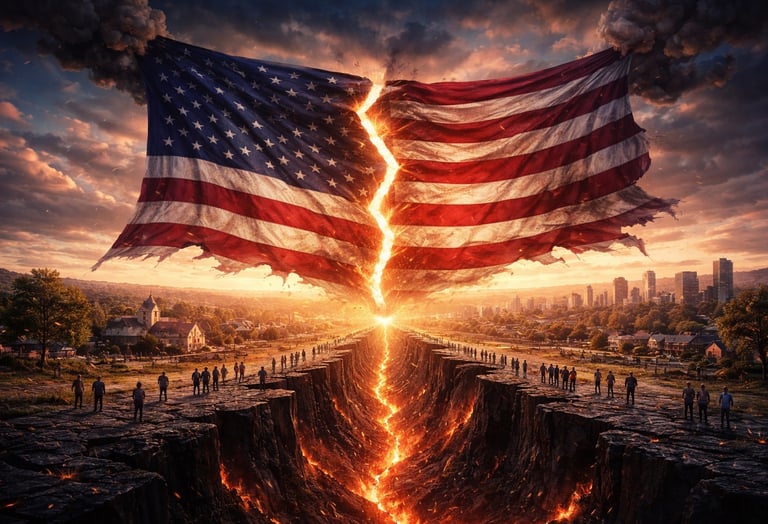
When Donald Trump labels nearly half of Americans as the “greatest enemy,” second only to a foreign adversary like Iran, it marks a dangerous turning point.
This is no longer political theater. It’s not campaign exaggeration. It’s a fundamental break from the most basic expectation of leadership in a democracy.
A president is supposed to unify. This does the opposite.
The Job He’s Refusing to Do
The presidency is not a factional role. It is not a position reserved for those who voted for you, donated to you, or agree with you.
It is a constitutional obligation to represent everyone.
That includes:
The people who oppose you
The people who criticize you
The people who will never vote for you
When a president starts describing those people as enemies, they are rejecting the core responsibility of the office. They are no longer attempting to lead a country—they are choosing to divide it into sides.
And once that line is drawn, it doesn’t stay rhetorical. It becomes the lens through which decisions are made.
From Political Opponent to “Enemy”
There is a clear and critical distinction between disagreement and demonization.
Democracy requires conflict. Debate, dissent, and opposition are not flaws in the system—they are the system. But calling your political opposition an “enemy” crosses a line that democracies are not designed to withstand.
Because “opponent” implies legitimacy.
“Enemy” implies threat.
And when millions of Americans are framed as a threat, it reshapes how they are treated—socially, politically, and potentially even legally.
This is how democratic norms erode:
First, language escalates
Then, distrust deepens
Then, justification follows
History shows this pattern over and over again. It never begins with action. It begins with words.
The Dangerous Power of Presidential Language
Words from a president are not just opinions—they are signals.
They shape how supporters interpret reality. They influence how institutions respond. They set the tone for what is acceptable in public life.
When a president identifies internal groups as the “greatest enemy,” the consequences ripple outward:
It normalizes hostility between citizens
It encourages suspicion over cooperation
It reframes political disagreement as existential conflict
In other words, it transforms a political system into a battleground.
And once politics becomes war in the minds of enough people, compromise becomes impossible. Every issue becomes a fight for survival rather than a problem to solve.
Unity Is Not Optional—It’s Foundational
The United States has never been a country of uniform beliefs. Its strength has always come from managing deep differences without breaking apart.
That requires a shared premise:
No matter how much we disagree, we are still part of the same national community.
When leadership abandons that premise, the consequences are severe. The idea of a unified country begins to weaken. Trust erodes. Institutions strain under the weight of division.
Unity doesn’t mean agreement. It means recognizing that disagreement does not make someone an enemy of the state.
Without that distinction, the entire democratic framework starts to crack.
A Presidency of One Side
By framing large portions of the population as enemies, Donald Trump is making a clear statement about how he views power.
Not as a responsibility to govern broadly—but as a tool to defend one group against another.
That is not how democratic leadership functions. That is how factional leadership operates.
And factional leadership has a predictable outcome: escalation.
Because if one side is told the other is an enemy, the expectation is not coexistence—it is defeat.
The Line That Should Not Be Crossed
There are many norms in politics that can be bent, stretched, or broken without immediately threatening the system.
This is not one of them.
Labeling millions of Americans as enemies is a line that strikes at the core of national identity. It reframes citizenship itself—not as a shared bond, but as a conditional status dependent on political alignment.
That is incompatible with a functioning democracy.
What This Moment Really Means
This moment isn’t just about one statement. It’s about what that statement represents.
It reveals a vision of America where:
Loyalty matters more than citizenship
Agreement matters more than rights
Division is not a side effect, but a strategy
And once that vision takes hold, the damage is not easily undone.
Because the hardest thing to rebuild in any country is not infrastructure or policy—it’s trust.
Unity
A president who sees half the country as the enemy is not misunderstanding America.
He is rejecting it.
And a nation built on the idea of unity in diversity cannot endure if its leader is actively working to erase that idea.
At that point, the question is no longer about politics.
It’s about whether the country can hold together at all.
AI Generated Image
trumpianinsanity.com © 2023-2025 All Rights Reserved
Trumpian Insanity empowers people with the knowledge and tools to participate in meaningful political discourse and contribute to positive change.
Reframe your inbox
Subscribe to my blog and never miss a story.
We care about your data in our privacy policy.