The Ghost of Jim Crow Never Left America
The fact that so many former Confederate states moved so aggressively to reduce Black political representation after federal protections weakened should terrify anyone who genuinely believes in democracy. Jim Crow is rearing its ugly head.
ELECTIONSCOURTSPOLITICSREPUBLICANSDEMOCRACY
For years, Americans were told that the country had evolved beyond the need for strong federal voting protections. Conservative politicians and Supreme Court justices argued that the worst days of racial discrimination were behind us, that America had changed, and that laws designed to protect Black voting rights were outdated relics of another era.
Then the protections weakened.
And almost immediately, many of the same former Confederate states with long histories of racial disenfranchisement began redrawing maps, restructuring districts, and pursuing voting laws that disproportionately reduced Black political representation.
That should end the debate right there.
If the moment federal oversight disappears and states rush to weaken Black voting power, then the protections were clearly still necessary. The behavior itself is the evidence.
What we are witnessing is not the disappearance of racism in American politics. It is the rebranding of it.
The Supreme Court Opened the Door
When the Supreme Court weakened key provisions of the Voting Rights Act, particularly the federal preclearance system that required states with histories of racial discrimination to get approval before changing voting laws, supporters framed the decision as proof that America had progressed.
The argument sounded simple: if the country was no longer openly racist, then extraordinary protections were no longer needed.
But that logic collapsed almost instantly.
States previously covered under federal oversight wasted little time implementing aggressive voter ID laws, closing polling locations, purging voter rolls, and drawing district maps that diluted Black political power. Laws and maps that likely would have faced federal scrutiny before were suddenly allowed to move forward until challenged after the damage had already begun.
The pattern became impossible to ignore.
The same regions that once fought desegregation, literacy test bans, and the Civil Rights Movement suddenly became laboratories for modern voter suppression.
Not all at once through dramatic acts of open segregation, but through technical legal maneuvers carefully designed to survive court challenges while producing the same practical outcome: reducing the political influence of Black voters.
Racism Didn’t Vanish. It Adapted.
One of the biggest myths in modern American politics is the idea that racism only counts if it resembles the imagery of the 1960s.
People imagine racism must look like burning crosses, police dogs, or governors physically blocking schoolhouse doors. If discrimination arrives dressed in legal language instead of open hatred, many Americans suddenly pretend they cannot recognize it.
But systems evolve.
After slavery ended, Southern states created Black Codes.
After Reconstruction expanded Black political participation, Jim Crow laws emerged.
After the Civil Rights Movement dismantled legalized segregation, politicians pivoted toward coded language about “states’ rights,” “law and order,” and “election integrity.”
Every era develops a cleaner vocabulary for preserving old power structures.
Modern voter suppression does not usually announce itself with racial slurs. It hides behind spreadsheets, district maps, administrative rules, and procedural jargon. It speaks in terms of “efficiency,” “fraud prevention,” and “partisan advantage.”
But the outcome remains strikingly familiar.
Black communities lose representation. Black voting strength gets fragmented. Black political influence weakens.
And somehow we are expected to believe race has nothing to do with it.
The Speed of the Backlash Says Everything
What makes this moment especially revealing is how quickly it happened.
If these states truly believed racial discrimination was over, they could have used the removal of federal oversight as an opportunity to prove critics wrong. They could have expanded access to voting, protected representation, and demonstrated genuine commitment to equal participation.
Instead, many moved in the opposite direction almost immediately.
That urgency exposed the truth.
The federal protections were not unnecessary government interference. They were restraints.
And once those restraints weakened, the political instincts underneath became visible again.
That is why the argument that “racism is over” rings hollow to so many Americans paying attention. Because when given freedom from oversight, too many state governments behaved exactly the way the Voting Rights Act was designed to prevent.
Democracy Cannot Function Selectively
Representation is not symbolic. It has real-world consequences.
Who gets elected determines where infrastructure money goes, which schools receive funding, how criminal justice policies are enforced, whose neighborhoods get environmental protection, and which communities are politically ignored.
Diluting representation is not just about elections. It is about power itself.
And when governments manipulate systems to weaken specific communities politically, democracy stops functioning equally.
That is the deeper danger here.
America often celebrates democracy as if it is self-sustaining, but history shows the opposite. Democratic systems require constant protection because those in power frequently attempt to reshape the rules in ways that preserve their own control.
The Voting Rights Act existed because America had already seen what happened without federal enforcement. The law was not created in response to hypothetical fears. It was created in response to systematic discrimination that lasted generations.
Weakening those protections while pretending the underlying impulses disappeared was either naive or deliberately dishonest.
The Myth of “Partisan, Not Racial”
Defenders of these maps often insist the issue is purely partisan, not racial. They argue the maps are designed to help Republicans, not specifically hurt Black voters.
But in much of the South, race and party identity are deeply connected because Black voters overwhelmingly support Democrats. Lawmakers understand this perfectly well.
Targeting Black communities politically often achieves the exact partisan result they want.
Using partisan language does not erase racial consequences.
That distinction has become one of the most effective political shields in modern America. As long as politicians avoid explicitly racist language, many institutions are willing to ignore blatantly unequal outcomes.
But people can see what is happening.
When heavily Black districts are repeatedly fractured, packed, or diluted while white conservative voting power is carefully preserved, the pattern speaks for itself.
America’s Original Sin Was Never Fully Confronted
The uncomfortable truth many Americans still resist is that the country never fully resolved its racial contradictions. It managed them. It rebranded them. It softened the language around them.
But it never truly eliminated them.
That is why battles over voting rights never fully disappear. They simply evolve with the times.
Every generation convinces itself the problem has been solved until the next wave of suppression exposes how fragile progress really is.
And that is exactly what we are witnessing now.
The weakening of voting protections did not create racism. It revealed how much of it was still waiting beneath the surface of American politics, restrained more by law than by genuine social transformation.
The Warning Americans Should Not Ignore
The lesson here is bigger than one court decision or one election cycle.
The lesson is that rights without enforcement are fragile.
Democracy without equal access becomes selective.
And nations that refuse to honestly confront their history often end up repeating it in updated forms.
The fact that so many former Confederate states moved so aggressively to reduce Black political representation after federal protections weakened should terrify anyone who genuinely believes in democracy. Jim Crow is rearing its ugly head.
Because it proves the fight was never truly over.
The language changed.
The tactics evolved.
The suits became more expensive.
The press conferences became more polished.
But the underlying goal remains painfully recognizable.
And pretending otherwise only guarantees the cycle continues.
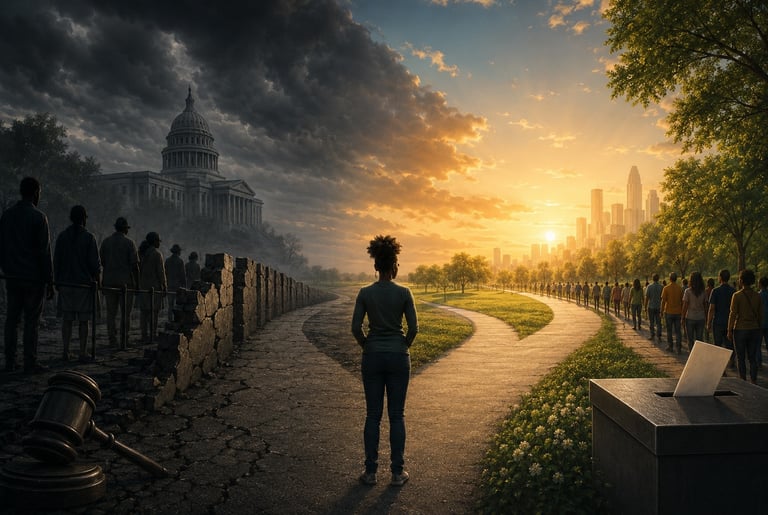
AI Generated Image
trumpianinsanity.com © 2023-2025 All Rights Reserved
Trumpian Insanity empowers people with the knowledge and tools to participate in meaningful political discourse and contribute to positive change.
Reframe your inbox
Subscribe to my blog and never miss a story.
We care about your data in our privacy policy.