Selective Outrage Is Not Patriotism — It’s Political Theater
Under Donald Trump, American troops are dying again — this time in a war of choice with Iran. Twelve service members gone. Twelve families shattered. Twelve futures erased. And yet, the voices that once dominated the airwaves with outrage have gone quiet.
TRUMPPOLITICSREPUBLICANS
There are moments in American life when tragedy is supposed to bring clarity.
When 13 U.S. service members were killed during the Afghanistan withdrawal under President Biden, the reaction from MAGA-aligned voices was immediate, loud, and relentless. It wasn’t just grief — it was fury. The loss was framed as a historic failure, a stain on the nation, proof of incompetence at the highest level. The outrage didn’t fade after a news cycle. It was sustained, amplified, and weaponized.
And to be clear — those 13 lives mattered. Their deaths deserved national mourning, accountability, and reflection.
But that standard didn’t hold.
Because now, under Donald Trump, American troops are dying again — this time in a war of choice with Iran. Twelve service members gone. Twelve families shattered. Twelve futures erased.
And yet, the voices that once dominated the airwaves with outrage have gone quiet.
Where Did the Outrage Go?
Where are the daily segments demanding answers?
Where are the calls for accountability?
Where is the righteous anger that once claimed to speak for the troops?
It didn’t evolve. It didn’t mature. It didn’t become more measured.
It vanished.
That disappearance isn’t subtle — it’s defining.
Because outrage that only exists when it’s politically useful isn’t outrage at all. It’s performance. It’s branding. It’s a tool deployed not in defense of human life, but in defense of power.
The Politics of Grief
What we are witnessing is not a difference in perspective. It is a difference in principle.
When tragedy is filtered through political convenience, it stops being about the people who died. Their names, their stories, their sacrifices — all of it becomes secondary to the narrative being constructed around them.
Grief becomes conditional.
Empathy becomes strategic.
And patriotism becomes a costume.
If 13 deaths under one administration are framed as unforgivable, then 12 deaths under another must carry the same moral weight. That is what consistency looks like. That is what integrity demands.
Anything less is hypocrisy.
Supporting Troops Means More Than Saying It
“Support the troops” has become one of the most overused phrases in American politics — and one of the most hollow.
Real support is not loud only when it’s convenient. It does not disappear when accountability becomes uncomfortable. It does not bend itself to protect a political figure.
Real support is consistent.
It means asking hard questions no matter who is in charge.
It means valuing every life equally, not selectively.
It means refusing to let sacrifice be reduced to a talking point.
Twelve American service members are dead. That fact alone should be enough to demand attention, scrutiny, and accountability.
The silence surrounding it is not accidental. It is chosen.
What Silence Reveals
Silence, in moments like this, is not neutrality. It is complicity.
It reveals that the previous outrage was never about honoring the fallen. It was about leveraging their deaths. It was about scoring points, assigning blame, and fueling a narrative.
Because when the same conditions produce a completely different reaction, the truth becomes impossible to ignore:
The outrage was never about the troops.
It was about politics.
The Bottom Line
If 13 deaths were a national disgrace, then 12 are too.
If one demanded accountability, so does the other.
If one mattered, they all do.
Anything less isn’t patriotism.
It’s propaganda.
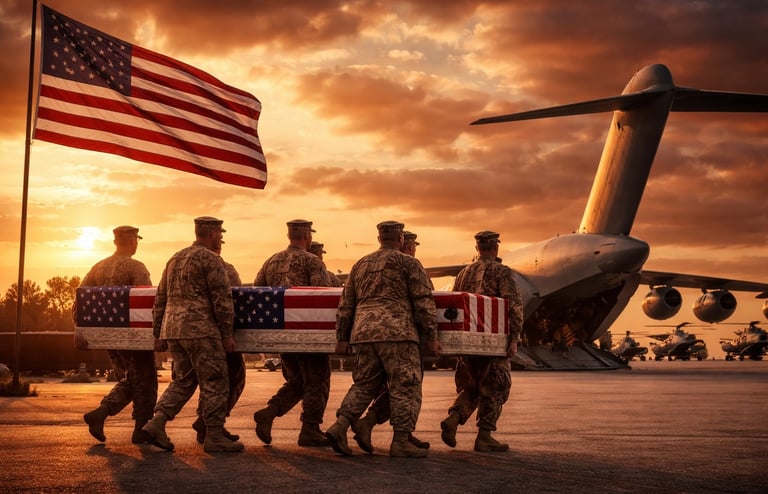
AI Generated Image
trumpianinsanity.com © 2023-2025 All Rights Reserved
Trumpian Insanity empowers people with the knowledge and tools to participate in meaningful political discourse and contribute to positive change.
Reframe your inbox
Subscribe to my blog and never miss a story.
We care about your data in our privacy policy.