Political Violence Is Contagious — And It’s Coming for All of Us
Political violence is not a tactic. It’s a disease. Once it’s unleashed into a society, it doesn’t stay contained. It spreads. It feeds on itself. It mutates and evolves, infecting movements and ideologies that once thought they were immune.
DEMOCRACYPOLITICSRIGHTSFREE SPEECH
Political violence is not a tactic. It’s a disease. Once it’s unleashed into a society, it doesn’t stay contained. It spreads. It feeds on itself. It mutates and evolves, infecting movements and ideologies that once thought they were immune.
History shows us this over and over again: violence in politics is never a scalpel, precise and controlled. It is a wildfire. Those who justify it in the name of their cause always believe they are the ones holding the torch. But in time, they are just as likely to be consumed by the flames.
And make no mistake—this is not some distant or abstract threat. It is happening here, now.
It Doesn’t Belong to One Side
We need to stop comforting ourselves with the lie that political violence is just a problem of “the other side.”
Violence does not care about your ideology. It does not respect party lines. It does not discriminate between “good” causes and “bad” ones. It is not a tool of justice. It is not an acceptable form of protest.
Whether it’s an armed mob storming a Capitol, extremists threatening school boards and election workers, a synagogue attacked out of antisemitism, a Pride event targeted with bullets, or politicians assaulted because of their beliefs—violence is violence.
The excuses change depending on who’s doing it. The justifications are dressed up in different language. But the outcome is always the same: fear replaces freedom.
Fear Is the Enemy of Democracy
The foundation of any free society rests on one principle: that citizens can participate without fear.
You can cast a ballot without worrying for your safety.
You can speak your mind without calculating whether it will make you a target.
You can gather in public, march in the streets, or show up at a local meeting without wondering if someone with a gun will be waiting.
The moment fear enters that equation, democracy begins to rot from the inside. Because when people are afraid, they withdraw. They silence themselves. They shrink from public life. And when only the loudest, angriest, or most violent voices are left standing, freedom has already been lost.
An Attack on One Is an Attack on All
This is why political violence is not just an attack on the person in the crosshairs.
It is an attack on everyone who watches from the sidelines and thinks, That could be me next.
It is an attack on the idea that we can settle disagreements with debate, persuasion, and the vote. It tells us instead that power belongs to whoever can scare the rest into silence.
That’s not democracy. That’s tyranny with extra steps.
The Danger of Excuses
Every time violence is excused or downplayed because it was “our side” doing it, the cycle deepens. Every time someone justifies it because the target “deserved it,” the disease spreads.
Political violence cannot be normalized, minimized, or compartmentalized. It must be condemned universally—no matter who does it, no matter who it’s aimed at, no matter the cause.
There are no acceptable exceptions. Not one.
The Line We Cannot Cross
This is the line we have to hold as a society. Because once political violence becomes an acceptable part of the process, democracy is no longer sustainable.
If you think it will stop at your enemies, you are wrong. If you think it will always be aimed outward, never at you, you are deluding yourself.
Political violence is contagious. And if we don’t reject it together—loudly, consistently, and without excuses—it will not just remain “their problem.”
It will become everyone’s problem.
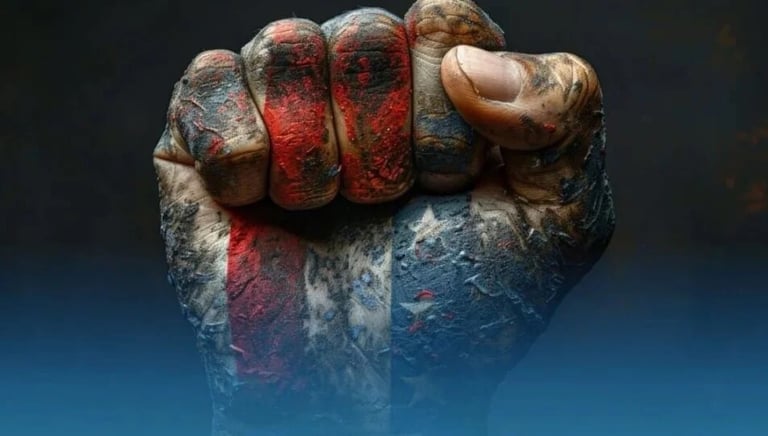
AI Generated Image
trumpianinsanity.com © 2023-2025 All Rights Reserved
Trumpian Insanity empowers people with the knowledge and tools to participate in meaningful political discourse and contribute to positive change.
Reframe your inbox
Subscribe to my blog and never miss a story.
We care about your data in our privacy policy.