Indictment Is Not Revenge — It’s the Rule of Law
Contrary to overheated talking points, Smith did not declare Trump guilty “beyond a reasonable doubt.” That standard belongs to a jury at trial. An indictment is not a conviction. It is the beginning of a legal process.
COURTSTRUMPDEMOCRACYCRIME
When federal prosecutors bring charges, they are not issuing vibes. They are not sending tweets. They are not speculating.
They are presenting evidence to a grand jury.
That is what Jack Smith did when he indicted Donald Trump over efforts to overturn the 2020 election.
Contrary to overheated talking points, Smith did not declare Trump guilty “beyond a reasonable doubt.” That standard belongs to a jury at trial. What Smith did was persuade a federal grand jury that there was probable cause to believe crimes had been committed — including conspiracy to defraud the United States and obstruction of an official proceeding tied to the certification of electoral votes.
An indictment is not a conviction. It is the beginning of a legal process.
But it is also not nothing.
What the Charges Actually Alleged
The indictment did not revolve around abstract complaints about election integrity. It laid out a structured set of allegations:
It alleged that Trump knowingly advanced false claims of widespread election fraud after being told repeatedly by senior advisers, campaign staff, White House lawyers, and Justice Department officials that those claims were unsupported by evidence.
It alleged that he pressured state officials to alter certified election results.
It alleged that he supported efforts to assemble alternate slates of electors in states he had lost.
It alleged that he attempted to use the Justice Department to lend credibility to claims of fraud that investigators had already debunked.
And it alleged that he pressured the Vice President to interfere with the counting of electoral votes on January 6.
These were not media narratives. They were formal criminal allegations presented in federal court.
Trump has denied all wrongdoing. He argues his actions constituted protected political speech and legitimate election challenges. His legal team has raised constitutional defenses, including presidential immunity, and has characterized the prosecution as politically motivated.
That is how the adversarial system functions: the government alleges, the defendant contests, and the courts decide.
When the Defendant Attacks the Prosecutor
Since being charged, Trump has not confined his response to legal arguments. He has repeatedly attacked Jack Smith personally — labeling him corrupt, illegitimate, and politically driven. He has publicly suggested that Smith should be investigated and has implied that those who prosecuted him should face criminal consequences.
There has been no formal court filing seeking Smith’s arrest. There has been no judicial finding that Smith fabricated evidence or committed criminal misconduct. But the rhetorical escalation is unmistakable.
This is not a conventional defense strategy. Most defendants challenge the sufficiency of evidence, the interpretation of statutes, or procedural issues. Trump has done those things. But he has also mounted a parallel political campaign aimed directly at the prosecutor.
That may be effective politics. It is not a legal rebuttal.
In the American system, prosecutors can be sanctioned or charged only if they violate laws or ethical rules. Disagreeing with a prosecution — even believing it to be unfair — does not meet that threshold. The rule of law requires proof of misconduct, not anger over being indicted.
The Real Constitutional Question
The deeper issue is not personal animosity between a former president and a special counsel.
It is about boundaries of power.
Can a sitting president use the machinery of government to challenge certified election results in ways that cross into criminal conduct? Where is the line between advocacy and conspiracy? Does presidential immunity extend to post-election efforts to interfere with the certification of votes?
These are not rhetorical questions. They are constitutional ones. And they are being addressed in courtrooms, not at rallies.
The Bottom Line
It is legally inaccurate to claim a prosecutor has already established guilt “beyond a reasonable doubt.” That determination belongs to a jury.
It is equally inaccurate to claim there was no evidence. A federal grand jury reviewed evidence and authorized charges.
The indictment of Donald Trump by Special Counsel Jack Smith represents something unprecedented: the legal system testing whether the actions of a former president crossed the line into criminal conduct. Trump disputes that claim. The courts will determine the outcome.
In a constitutional republic, that process is not revenge.
It is accountability — carried out under the law, not above it.
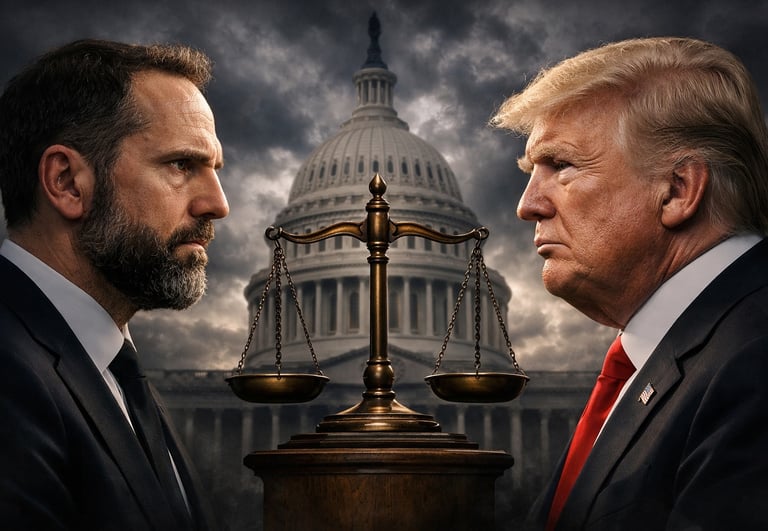
AI Generated Image
trumpianinsanity.com © 2023-2025 All Rights Reserved
Trumpian Insanity empowers people with the knowledge and tools to participate in meaningful political discourse and contribute to positive change.
Reframe your inbox
Subscribe to my blog and never miss a story.
We care about your data in our privacy policy.