If GOP Policies Are So Good, Why Are Red States Doing Bad?
If Republican policies are better for the economy and society, why do Republican-led states consistently rank among the poorest, least educated, and least healthy in the nation?
REPUBLICANSPOLITICSECONOMICSEDUCATIONHEALTHCAREHISTORY
It’s a fair question — one that deserves more than a slogan or a social-media meme.
If Republican policies are better for the economy and society, why do Republican-led states consistently rank among the poorest, least educated, and least healthy in the nation? Why do so many rely heavily on the very federal aid and welfare programs their leaders so often denounce?
It’s not a partisan talking point — it’s a statistical pattern. But the real story behind that pattern is a lot more complex, and revealing, than most political debates allow.
The Numbers Don’t Lie — But They Don’t Tell the Whole Story Either
Start with the basics:
The states with the highest poverty rates — Mississippi, Louisiana, West Virginia, Arkansas — are all Republican strongholds. The states with the lowest levels of educational attainment, the most chronic health problems, and the lowest median household incomes? Same list, give or take.
And then there’s dependence on federal programs. The states that take in the most in federal dollars per tax dollar sent? Again — overwhelmingly red. It’s a dynamic sometimes called “Moocher vs. Maker States” — though that framing misses the point. This isn’t about moral worth. It’s about structure.
The Geography Trap
For starters, most Republican-leaning states are more rural. Rural America is beautiful — but economically fragile.
Rural economies rely heavily on agriculture, resource extraction, and low-margin industries that don’t generate the same level of wealth as tech, finance, or high-end services concentrated in cities. Urban areas, where Democrats dominate, produce the bulk of GDP, innovation, and high-wage jobs. It’s not ideology — it’s geography.
You can’t legislate your way into a Silicon Valley if you don’t have the infrastructure, universities, or population density to support it.
History’s Long Shadow
There’s also history — the kind that doesn’t fade just because a party realigns.
Many Southern and Appalachian states were locked into poverty long before they were Republican. Generations of underinvestment in education, racial segregation, weak labor protections, and reliance on extractive industries created structural disadvantages that persist today.
You don’t flip that script in a few election cycles.
Policy Choices That Matter
Still, politics plays a role.
Republican-led states are far less likely to have expanded Medicaid under the Affordable Care Act. They tend to spend less per pupil on education, keep taxes lower on the wealthy and corporations, and invest less in public health and infrastructure.
These policies are consistent with small-government ideology — but they come with trade-offs. Less public spending means fewer public resources. It’s hard to build a healthy, educated workforce on a shoestring budget.
Culture and Migration
People with degrees and higher incomes tend to cluster in places with opportunity, amenities, and tolerance — which often means blue states and blue cities. That’s not political preference so much as self-selection. Over time, that migration compounds inequality between states.
Meanwhile, many red states lose young talent to blue-state metros, draining the very human capital they need to reverse the trend.
The Complicated Truth
So, do Republican policies cause poor outcomes? Not entirely. But they often reinforce existing disadvantages.
Do Democratic policies magically fix everything? Hardly. But they tend to invest more in the long game — education, healthcare, infrastructure — the foundations of prosperity.
When politicians claim their policies are “better for the economy,” it’s worth asking: better for whose economy? A low-tax system that attracts corporations can still leave citizens sick, underpaid, and undereducated.
The Real Question
Maybe the question isn’t just “Why are Republican states poorer?”
Maybe it’s “Why, despite being poorer, do so many voters keep trusting the same approach?”
That’s where culture, identity, and distrust of institutions collide with policy. When political identity becomes more powerful than evidence, data stops mattering. And the cycle continues.
Final Thought
The next time someone claims one party has the “better policies,” ask them to point to the scoreboard — not the slogan.
Because prosperity isn’t built on ideology. It’s built on investment, opportunity, and trust — three things that no state, red or blue, can afford to neglect.
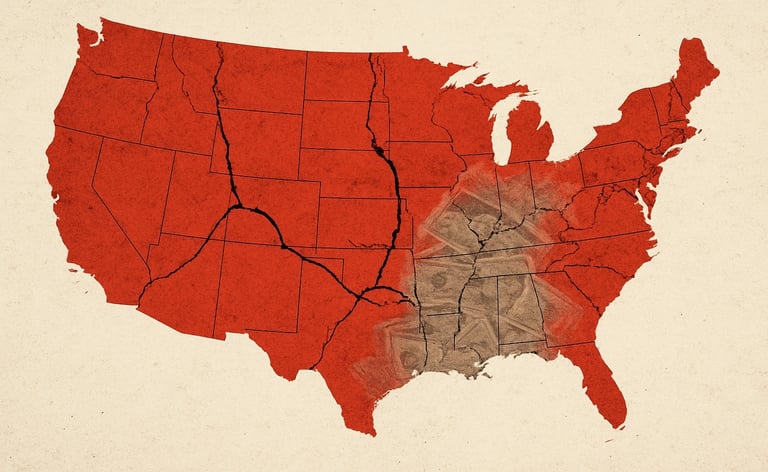
AI Generated Image
trumpianinsanity.com © 2023-2025 All Rights Reserved
Trumpian Insanity empowers people with the knowledge and tools to participate in meaningful political discourse and contribute to positive change.
Reframe your inbox
Subscribe to my blog and never miss a story.
We care about your data in our privacy policy.