How the Court Became Trump’s Shield and Biden’s Noose
The Supreme Court of the United States was once regarded as the ultimate guardian of constitutional balance — a place where ideology bowed, at least nominally, to the rule of law.
COURTSHISTORYPOLITICSTRUMP
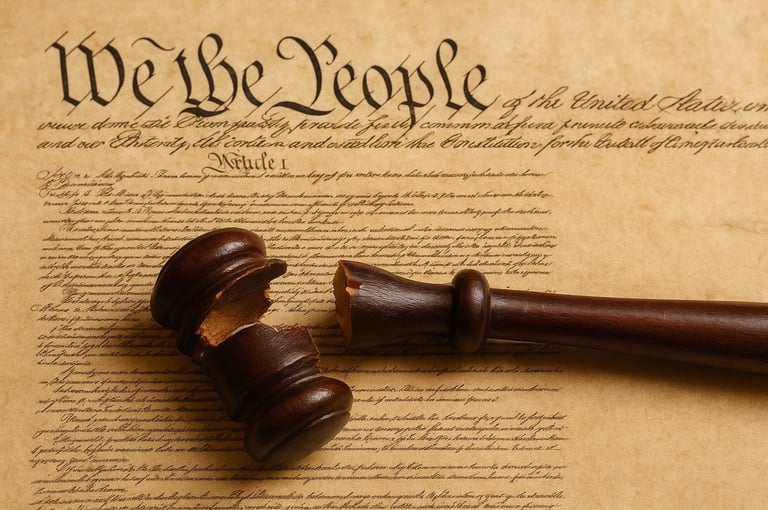
A Court Divided by Power, Not Principle
The Supreme Court of the United States was once regarded as the ultimate guardian of constitutional balance — a place where ideology bowed, at least nominally, to the rule of law. But in this era, that balance has evaporated.
When President Joe Biden sought to cancel a portion of student loan debt for millions of Americans — a modest measure intended to alleviate crushing financial burdens and stimulate economic growth — the Court ruled that he lacked the authority to act without explicit congressional approval. The decision was presented as a defense of separation of powers, a noble stand against executive overreach.
But that same Court, now faced with the possibility of Donald Trump returning to power with openly stated plans to dismantle entire federal agencies, fire civil servants at will, and assume near-total control over the machinery of government, appears to see no such constitutional red flags.
The contrast is not just alarming — it is defining. It tells us exactly what this Court has become.
The Illusion of Neutrality
The Court’s conservative majority has spent years cultivating the image of strict constitutionalism — the idea that their decisions are grounded not in ideology, but in faithful adherence to the Founders’ intent. Yet, when we look closely, the rulings reveal a pattern not of neutrality, but of selective enforcement.
For Biden, every executive action becomes an “abuse of power.”
For Trump, every abuse becomes “executive authority.”
Whether it’s environmental protections, student debt relief, immigration policy, or pandemic response, Democratic presidents are repeatedly told their reach exceeds the law. Republican presidents, on the other hand, are gifted new legal theories — the “unitary executive,” “presidential immunity,” and “deference to executive discretion” — that expand their reach beyond anything the Framers could have imagined.
The supposed principle of “limited government” has become, in practice, a weapon used to limit only one side.
A Court in Service of a Movement
This is not judicial philosophy — it is political allegiance wrapped in Latin phrases and legal citations.
In case after case, the Court’s conservative bloc has aligned with partisan interests that mirror the priorities of the modern right: deregulation, corporate immunity, Christian nationalism, and executive supremacy under Trump.
Their rulings have chipped away at voting rights, gutted campaign finance limits, stripped away reproductive autonomy, and eroded the administrative state — all while preaching the sanctity of “originalism.”
Yet “originalism” never seems to apply when Trump is involved. When he threatens to defy the Constitution, dismantle the Department of Justice, or purge the civil service, these justices — who claimed to fear government tyranny — are suddenly silent. The same Court that claimed Biden’s student loan plan would “undermine democracy” now entertains arguments that would place a president above the law entirely.
The Erosion of Judicial Legitimacy
The Court’s credibility has collapsed under the weight of its contradictions. Polls show confidence in the institution at historic lows — and for good reason. When justices accept undisclosed luxury trips, fail to recuse themselves from politically entangled cases, and appear at partisan gatherings, the perception of impartiality is not merely damaged — it’s destroyed.
The rule of law cannot survive if citizens believe that outcomes depend on ideology rather than evidence, on partisanship rather than principle. A democracy cannot endure when one branch of government has effectively joined a political movement.
This is not simply about disagreement over policy. It is about the corrosion of trust — the quiet unraveling of the judicial system as an independent check on power.
A Warning from History
History offers grim reminders of what happens when courts align themselves with strongmen and political factions. From Dred Scott to Plessy v. Ferguson, the Supreme Court has erred before — gravely and morally. But in each of those moments, America still believed the Court could, in time, correct itself.
Today, that hope feels dimmer. The current majority seems less interested in course correction than in consolidation. They are not content to interpret the Constitution; they are rewriting the relationship between government and governed, between law and power.
And unless something changes — unless Congress reclaims its role, unless judicial ethics reform becomes more than a talking point, unless the public demands accountability — this Court will continue to tilt the scales of justice toward authoritarianism.
The True Crisis: Unequal Power, Unequal Justice
The Supreme Court has made clear that there are two presidencies in America: one constrained by law, and another liberated from it. One must seek Congress’s blessing to forgive a debt; the other may dissolve entire agencies by fiat.
This is not constitutional balance. It is constitutional betrayal.
The Founders designed checks and balances precisely to prevent one man — or one faction — from accumulating unchecked authority. Today’s Court has inverted that design. It has become an instrument of that very concentration of power.
This is the most compromised, partisan, and unethical Supreme Court in generations. It is not defending democracy; it is redefining it — and not for the better.
The question now is not whether the Court can regain legitimacy, but whether democracy can survive while it lacks it.
AI Generated Image
trumpianinsanity.com © 2023-2025 All Rights Reserved
Trumpian Insanity empowers people with the knowledge and tools to participate in meaningful political discourse and contribute to positive change.
Reframe your inbox
Subscribe to my blog and never miss a story.
We care about your data in our privacy policy.