How America Looks Thru Party Eyes: One Nation, Two Visions
Ask a Republican and a Democrat to describe America, and you might wonder if they’ve been living in the same country, on the same planet or even in the same reality.
DEMOCRATSREPUBLICANSCULTUREFREE SPEECHHEALTHCAREEDUCATIONECONOMICSMEDIAPOLITICS
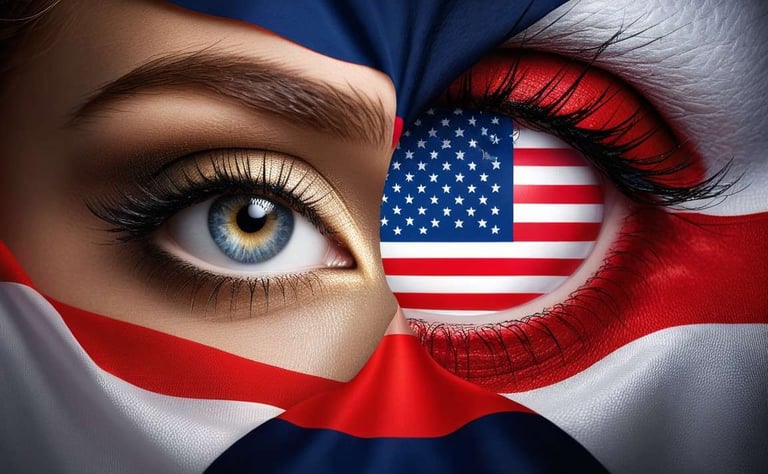
Ask a Republican and a Democrat to describe America, and you might wonder if they’ve been living in the same country—or even on the same planet. To one, the United States is a land of rugged individualists, building prosperity through grit, free markets, and a restrained government. To the other, it is a community bound by shared responsibilities, where justice and opportunity require collective action and a government capable of shaping fair outcomes.
Same Constitution, same flag, same pledge. But the stories diverge the moment you ask: What does America mean?
The Role of Government: Evil or Partner?
Conservatives often see government as a necessary evil: it exists to defend borders, enforce laws, and otherwise step aside. In this view, Washington is a lumbering bureaucratic giant that grows fat on freedom the larger it becomes.
Liberals, by contrast, cast government as a necessary partner: flawed, yes, but the only institution with the scale to ensure fairness in healthcare, protect the environment, or rein in corporate excesses. For them, government is the referee that keeps the game honest—without it, the strongest players simply rewrite the rules.
Individualism vs. Community
Republicans invoke the pioneer spirit: individuals and families charting their own destiny, unencumbered by outside interference. It’s the mythos of the self-made man—John Wayne with a smartphone.
Democrats emphasize community. Freedom, in their telling, isn’t merely the absence of restraint but the presence of opportunity: affordable education, accessible healthcare, equal rights. The single mother who cannot afford childcare is hardly “free” unless society lends a hand.
Patriotism, Past and Future
Both parties wave the flag, but they salute different Americas. Conservatives lean toward a nation rooted in tradition, faith, and cultural continuity—patriotism as loyalty to a legacy. Progressives highlight America as a work in progress, defined less by its past than by its promise. Patriotism, here, is not only pride but critique: the belief that true love of country means demanding it live up to its ideals.
When Philosophy Meets Policy
These contrasting philosophies filter down into the details of governance:
Economy: Republicans argue that tax cuts and deregulation unleash growth. Democrats counter that prosperity must be broadly shared, and markets left alone tend to concentrate wealth.
Healthcare: Conservatives treat it as a consumer good, best delivered by competition. Liberals see it as a right, no different from public safety or clean water.
Immigration: The right stresses sovereignty and security—without borders, no nation. The left emphasizes inclusion and humanitarian values—without immigrants, no America.
Social Issues: Republicans defend tradition as social glue; Democrats push progress as moral necessity.
The battles are not simply about solutions—they begin with different definitions of the problem itself.
Shared Myths, Divergent Stories
Here lies the irony: both parties claim to be guardians of freedom, democracy, and the Constitution. They simply define those terms differently.
Republicans stress freedom as freedom from government intrusion. Democrats stress freedom as freedom through equal opportunity. Republicans celebrate democracy as majority rule; Democrats warn that democracy without protections can devolve into tyranny of the majority.
It is the same vocabulary, but with two dictionaries.
Two Movie Scripts, One Country
The United States is not merely divided between red and blue states; it is divided between competing storylines. In one script, the hero is the lone individual overcoming obstacles through grit and faith. In the other, the hero is the community, striving together against systemic barriers.
Both films are set in the same place, but they unfold in parallel universes. And, of course, both sides believe they are holding the director’s chair.
The Rorschach Republic
America is less a melting pot than a political Rorschach test: one image, two visions. Conservatives see liberty endangered by government overreach; liberals see liberty endangered by inequality and neglect. Both are, in their own ways, right. Both are, in their own ways, talking past each other.
The question isn’t simply who’s right about America? but can a country endure when its citizens see such different Americas staring back at them?
AI Generated Image
trumpianinsanity.com © 2023-2025 All Rights Reserved
Trumpian Insanity empowers people with the knowledge and tools to participate in meaningful political discourse and contribute to positive change.
Reframe your inbox
Subscribe to my blog and never miss a story.
We care about your data in our privacy policy.