Free Speech: Donald Trump and His Broken Promise
Trump has frequently framed himself as a defender of free speech, especially when criticizing “cancel culture” or social media platforms.
FREE SPEECHTRUMP
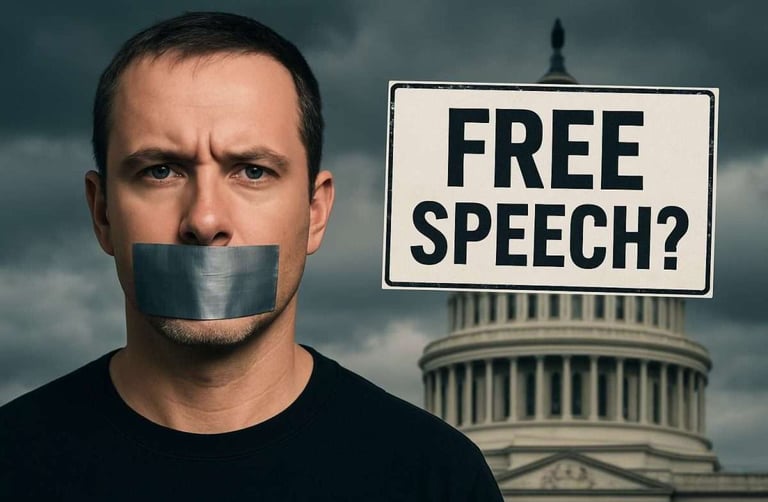
Trump has frequently framed himself as a defender of free speech, especially when criticizing “cancel culture” or social media platforms. For example, he has claimed that government and tech companies are silencing conservatives, presenting himself as a champion of unrestricted expression.
Trump's Promise
At his second inauguration, Donald Trump stood before the country and declared:
“After years and years of illegal and unconstitutional federal efforts to restrict free expression, I will sign an executive order to immediately stop all government censorship and bring back free speech to America.”
It sounded sweeping, even historic. The promise of restoring free expression touched on something deeply American: the belief that no government should dictate what we can read, say, or think.
But the reality since then has been the exact opposite. Trump and his allies have not expanded free speech—they’ve narrowed it, weaponized it, and turned it into a partisan tool.
Free Speech for Some, Silence for Others
When Trump and his movement talk about “free speech,” it is clear they do not mean freedom for everyone. What they mean is freedom for themselves and their allies, paired with restrictions on anyone who challenges them.
The results are everywhere:
Book Bans: In state after state, books by Black authors, LGBTQ+ writers, and others who present perspectives outside the MAGA worldview are being pulled from libraries and classrooms. This is not protecting children—it is government censorship, plain and simple.
Classroom Restrictions: Teachers and professors are being told what they can and cannot say about race, gender, and history. Entire courses are being banned because they don’t fit the preferred political narrative. That is not free expression—it’s state control of thought.
Crackdowns on Protest: Laws have been passed that make it easier to arrest and prosecute protesters, especially those who demonstrate against police brutality or environmental destruction. The right to peacefully assemble is at the core of the First Amendment. Curtailing it is not “law and order”—it’s suppression.
Attacks on the Press: Trump has repeatedly called the press “the enemy of the people” and pushed for changes to libel laws that would make it easier to silence journalists. A free press is the backbone of democracy, and undermining it is one of the clearest attacks on free speech imaginable.
The Pattern Is Clear
This is not a defense of free speech—it’s selective permission.
When Trump and his allies want to spread falsehoods and conspiracy theories, they demand “free expression.”
When critics, journalists, teachers, or activists speak out, they move to silence them.
Free speech has never been about protecting only the voices you agree with. It has always been about ensuring the liberty of all voices, especially the ones you find uncomfortable.
The Real Fight for Free Expression
Here’s the truth: Free speech is messy. It’s uncomfortable. It means protecting voices you hate just as fiercely as the ones you love.
Trump doesn’t want free speech. He wants obedience. He wants a country where the only acceptable words are “Yes, sir” and “Four more years.”
Free Speech Belongs to the People
The defense of free speech cannot be left in the hands of people who see it as a partisan weapon. It belongs to us—to the readers, the teachers, the librarians, the students, the protesters, and the journalists.
If they’re going to shrink free speech to fit inside a MAGA hat, then it’s on us to rip that hat off and remind America that liberty doesn’t come with conditions.
Free speech isn’t theirs to give or take away. It’s ours to defend. And we’d better defend it—loudly—before the only voices left are the ones telling us to shut up.
AI Generated Image
trumpianinsanity.com © 2023-2025 All Rights Reserved
Trumpian Insanity empowers people with the knowledge and tools to participate in meaningful political discourse and contribute to positive change.
Reframe your inbox
Subscribe to my blog and never miss a story.
We care about your data in our privacy policy.