Follow the Resources: Trump’s Foreign Policy Was Never Random
Trump’s foreign policy is often defended as chaotic, impulsive, or ideologically incoherent. But that framing lets it off the hook. Strip away the bluster and a consistent pattern emerges—one that is both simpler and far more cynical.
TRUMPPOLITICSECONOMICSDEMOCRACYHISTORY
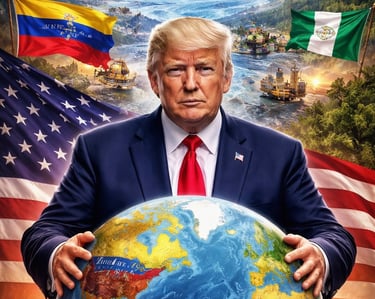
Trump’s foreign policy is often defended as chaotic, impulsive, or ideologically incoherent. But that framing lets it off the hook. Strip away the bluster, the grievances, and the strongman theatrics, and a consistent pattern emerges—one that is both simpler and far more cynical.
Follow the resources.
The Countries Trump Fixated On Were Never Accidental
Look at the map of Trump-era foreign policy conflicts and “interests,” and then look at a map of global resources.
Venezuela sits on the largest proven oil reserves on Earth.
Nigeria is Africa’s largest oil producer, a cornerstone of global energy supply.
Greenland holds one of the largest undeveloped rare-earth mineral deposits outside of China—minerals essential for military hardware, batteries, semiconductors, and advanced technology.
These are not coincidences. They are leverage points in the global economy.
Trump didn’t “randomly” threaten Venezuela, cozy up to oil-rich autocrats, or float the idea of buying Greenland like it was a distressed golf course. His administration consistently gravitated toward regions where control of energy and strategic minerals translates directly into power.
“America First” Was a Branding Exercise, Not a Strategy
The rhetoric was nationalist. The reality was extractive.
“Energy dominance” wasn’t about sustainability, national security, or independence for American workers—it was about market control. Control oil, influence prices. Control rare earths, dominate the supply chains that underpin modern weapons systems and emerging technology.
That’s why human rights concerns disappeared the moment they became inconvenient. It’s why sanctions were weaponized selectively. It’s why authoritarian leaders were praised while democratic norms were dismissed as “weakness.”
Values didn’t guide policy. Commodities did.
Venezuela: Regime Change Wrapped in Oil
Nowhere was this clearer than Venezuela. The moral language—democracy, freedom, humanitarian concern—was front-facing. But behind the curtain was the blunt reality: Venezuela controls more oil than Saudi Arabia.
Sanctions crippled the economy. Regime-change rhetoric escalated. Diplomacy was replaced with pressure campaigns that hurt civilians far more than leadership. The message was unmistakable: sovereignty is negotiable when oil reserves are large enough.
This wasn’t about helping Venezuelans. It was about who controls the tap.
Africa: Invisible Until It Isn’t
Africa barely registered in Trump’s worldview—until it did. When it came to oil production, counterterrorism pipelines, or resource extraction, suddenly certain nations mattered. Nigeria, in particular, fit neatly into the framework: energy-rich, geopolitically strategic, and vulnerable to external pressure.
The continent wasn’t engaged as a partner. It was treated as a resource field.
Greenland: The Mask Slipped Completely
Then there was Greenland—the moment when the quiet part was said out loud.
Greenland’s strategic value isn’t its population or its culture; it’s what lies beneath the ice. Rare earth minerals. Shipping lanes. Military positioning in a warming Arctic. Trump’s suggestion that the U.S. could simply buy Greenland revealed the worldview in its purest form: land, people, and sovereignty reduced to an asset ledger.
This wasn’t diplomacy. It was colonial logic, updated for the 21st century.
Corporate Imperialism With a Flag Draped Over It
Despite the nationalist branding, this approach is deeply globalist in the most predatory sense. It treats nations as resource nodes, governments as obstacles, and international law as optional when it interferes with extraction or leverage.
The irony is brutal: while railing against “global elites,” Trump’s foreign policy operated exactly like a corporate takeover strategy—identify valuable assets, undermine resistance, apply pressure, extract value.
This Is the Pattern. Ignore It at Your Own Risk.
Once you see the pattern, it’s impossible to unsee it. The targets line up too cleanly. The justifications change, but the destinations don’t.
This wasn’t incoherence.
It wasn’t toughness.
It wasn’t patriotism.
It was resource-driven power politics, dressed up as populism and sold to the public as strength.
Trump’s foreign policy wasn’t about defending democracy or protecting American values.
It was about who owns the oil, who controls the minerals, and how aggressively the United States was willing to take or threaten them.
Follow the resources.
The rest is just noise.
AI Generated Image
trumpianinsanity.com © 2023-2025 All Rights Reserved
Trumpian Insanity empowers people with the knowledge and tools to participate in meaningful political discourse and contribute to positive change.
Reframe your inbox
Subscribe to my blog and never miss a story.
We care about your data in our privacy policy.