Election of Obama Exposed the Division We Said Didn’t Exist
When Barack Obama was elected in 2008, the world watched in awe. Here was the United States — a country built on the labor of enslaved people, — electing its first African American president.
ELECTIONSDEMOCRACYHISTORYDEMOCRATSREPUBLICANSPOLITICSFEATURED
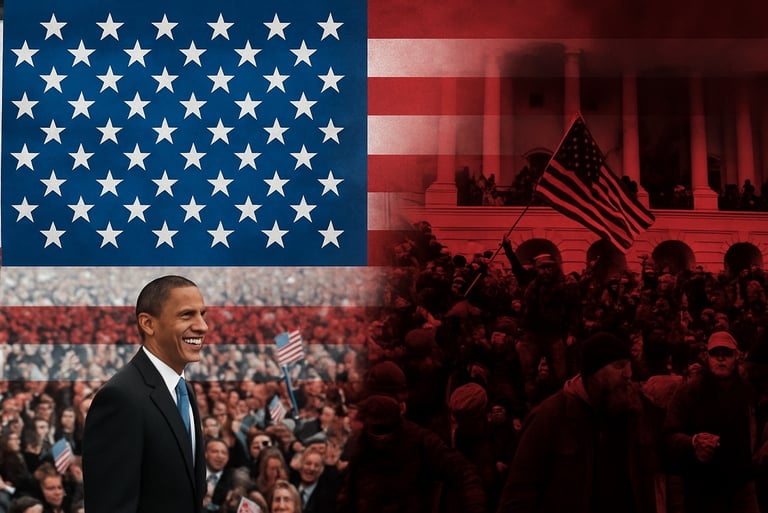
A Moment of Triumph — and Terror
When Barack Obama was elected in 2008, the world watched in awe.
Here was the United States — a country built on the labor of enslaved people, a country that once codified Black inferiority into its founding laws — electing its first African American president.
For many, it was a transcendent moment. The tears in the eyes of civil rights veterans. The joyous crowds filling the streets. The sense that perhaps, finally, the nation had turned a corner toward the better angels of its nature.
But for others, it was a nightmare.
To racists, white nationalists, and those who had long defined “American” in exclusively white terms, Obama’s victory was an existential crisis. It wasn’t simply that a Democrat had won. It was that a Black man had. The unspoken racial hierarchy they depended upon to make sense of their world had just been shattered on live television.
The Myth of a Post-Racial America
In the euphoric aftermath of the election, pundits rushed to declare that America had entered a “post-racial” era. They said racism had been conquered, that the Civil Rights Movement had reached its glorious conclusion, and that the color of a person’s skin no longer mattered.
But underneath that hopeful narrative, something else was brewing.
The very next day, online forums and talk radio hosts began questioning Obama’s legitimacy. “Is he really American?” “Was he born here?” “Is he one of us?”
The “birther” conspiracy wasn’t a harmless fringe theory — it was the beginning of a cultural counterattack. It gave voice to a deep-seated fear that the traditional, white-dominated order of American life was slipping away. And when that fear was weaponized by opportunists and demagogues, it turned into something far uglier.
The Backlash Becomes a Movement
Obama’s mere existence in power radicalized millions of Americans who had never before engaged politically.
They saw his family in the White House and felt personally displaced — as if they’d been replaced in their own story.
The Tea Party erupted almost overnight, draped in the language of “small government” and “freedom,” but fueled by resentment and coded racial anxiety. Town halls turned into shouting matches. Confederate flags began reappearing in the public square.
And the Republican Party, sensing an opportunity, didn’t calm the fire — it poured gasoline on it.
What began as racist whisper campaigns morphed into a political identity: white grievance as ideology.
By the time Obama left office, those who once hid their racism in euphemisms had grown bolder, louder, and prouder of it. The backlash didn’t stay in the shadows. It organized, voted, and eventually found its perfect avatar.
Trump: The Symptom, Not the Cause
Donald Trump didn’t create the division in America. He exploited it.
He rose to power on the same lies that began the moment Barack Obama took office — the lie that America was being “taken away,” that “real Americans” were losing their country.
His political life began with birtherism and ended with an attempted coup. That’s not a coincidence; it’s a straight line.
Trumpism was the emotional catharsis for those who never accepted a Black president. It was a movement built on revenge — a promise to undo the progress symbolized by Obama’s presidency.
When Trump said, “Make America Great Again,” what many of his followers heard was, “Make America White Again.”
The Division Didn’t Start — It Was Exposed
So when people say the division in America “started with Obama,” they are both right and wrong.
Yes, the visible division — the open hostility, the weaponized hatred, the conspiracy-fueled rage — surged during and after his presidency.
But Obama didn’t cause it. He revealed it.
He was the mirror in which America finally saw its unhealed wounds.
His election didn’t divide us; it forced us to confront the division we’d long denied existed.
The racism, the paranoia, the nationalism — all of it had been there, just waiting for a catalyst. Obama’s victory didn’t create new hate; it simply brought the old hate out into the daylight.
A Nation Still in Recovery
More than a decade later, we’re still living in the shadow of that revelation.
We’ve seen what happens when fear overtakes hope — when nostalgia replaces progress — when lies become more powerful than truth.
But we’ve also seen what the other side looks like: a multiracial, forward-looking America that refuses to be silenced or erased. The millions who believed in the promise of that 2008 night are still here, still voting, still fighting for the idea that democracy means everyone belongs.
The arc of American history is still bending — but it’s bending through fire.
The Lesson We Keep Forgetting
Barack Obama didn’t divide America.
He simply removed the mask.
And the real question we face now isn’t whether the hate will ever vanish — it’s whether we’ll have the courage to keep moving forward, knowing exactly what we’re up against.
Because the moment we elected our first Black president, we found out who we truly are — not the myth, not the slogan, but the truth.
And the truth, once revealed, can never be unseen.
AI Generated image
trumpianinsanity.com © 2023-2025 All Rights Reserved
Trumpian Insanity empowers people with the knowledge and tools to participate in meaningful political discourse and contribute to positive change.
Reframe your inbox
Subscribe to my blog and never miss a story.
We care about your data in our privacy policy.