Detention Is Not Deportation: What Are We Actually Paying For?
If you voted for mass deportation, you were promised removal. What you’re getting instead is expansion—of detention. There’s a difference. And taxpayers are funding it.
IMMIGRATIONPOLITICSTRUMPECONOMICSREPUBLICANSRIGHTSCRIME
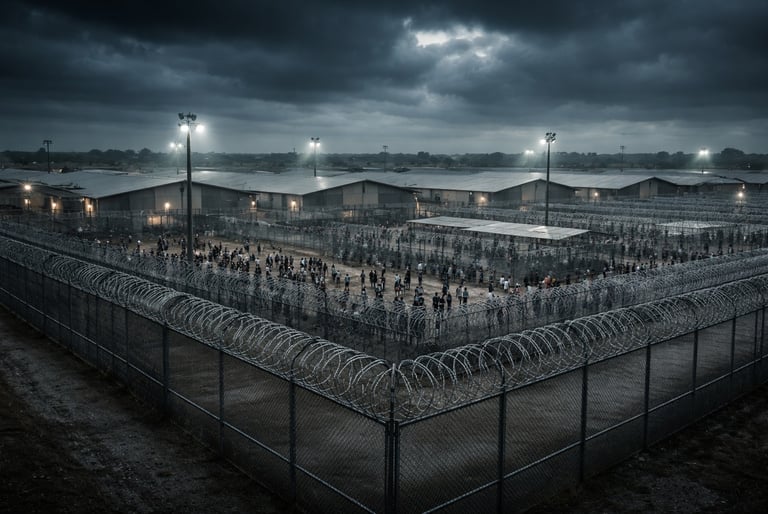
If you voted for mass deportation, you were promised removal.
What you’re getting instead is expansion—of detention.
There’s a difference.
And taxpayers are funding it.
The Detention State Is Expanding
The United States is currently holding tens of thousands of immigrants in detention facilities across the country. Many are asylum seekers. Many have no criminal convictions. All are in civil custody, not serving criminal sentences.
Immigration detention is not a prison sentence. It is supposed to be administrative—temporary custody while a case is processed.
But “temporary” increasingly looks indefinite.
The immigration court backlog has climbed into the millions. Hearings are delayed for months, sometimes years. While cases crawl forward, people sit in facilities run or contracted by companies like CoreCivic and GEO Group.
These companies are paid per bed, per day.
If you were designing a system to prioritize swift deportations, you would:
Dramatically increase immigration judges.
Expand legal processing capacity.
Invest in case resolution infrastructure.
Accelerate diplomatic agreements for repatriation.
Instead, we invest heavily in beds.
Civil Detention, Criminal Conditions
Let’s be precise.
Immigration detention is civil. It is not criminal punishment.
Yet investigations by organizations such as the American Civil Liberties Union and reporting from outlets including The Washington Post have documented recurring concerns: overcrowding, medical neglect, prolonged confinement, and limited access to counsel.
This creates a strange contradiction:
People are not convicted criminals.
But they are confined in conditions that often resemble incarceration.
And they remain there while their cases stall.
Detention becomes less about processing and more about containment.
The Incentive Problem No One Wants to Talk About
When private companies are paid per occupied bed, empty beds are lost revenue.
That doesn’t automatically mean corruption. It does mean incentives matter.
If detention levels rise, contracts expand.
If contracts expand, communities become economically dependent on facilities.
If facilities become economic anchors, political pressure shifts toward keeping them full.
This is not ideology. It is basic structural economics.
When detention becomes an industry, policy choices can drift.
About the Historical Comparison
Some observers have pointed out that the number of people currently detained in the U.S. immigration system exceeds the number of prisoners held in Nazi concentration camps in early 1939, before World War II began.
The numerical comparison is striking.
But we need clarity:
The Nazi camp system was part of a totalitarian regime explicitly built on racial extermination and authoritarian control.
The U.S. immigration system operates within a constitutional framework that includes courts, elections, media scrutiny, and ongoing litigation.
The regimes are not equivalent.
But scale matters. Normalization matters.
The question isn’t whether America is Nazi Germany. It isn’t.
The question is whether large-scale, indefinite civil detention is becoming politically routine.
The Warehouse Question
Here’s the part that deserves serious attention.
The federal government has demonstrated that it can:
Rapidly contract facilities.
Retrofit large warehouse spaces.
Mobilize staff and logistics at scale.
Fund ongoing operations costing billions.
If that capacity exists for confinement, it exists for other purposes.
Emergency housing.
Community stabilization.
Workforce development.
Education and integration centers.
Infrastructure is not the limiting factor.
Political will is.
Budgets are moral documents. They reveal priorities.
Who Is This System Actually Serving?
If you supported hardline immigration enforcement because you believed it would lead to rapid deportations, you should be asking whether that is happening.
Are cases moving faster?
Is the backlog shrinking?
Are removals increasing proportionally to detention?
Or are we funding prolonged custody while legal bottlenecks remain unresolved?
Detention without acceleration of adjudication is not efficiency. It is warehousing.
And warehousing is expensive.
Taxpayers fund:
Daily bed rates.
Medical contracts.
Transportation.
Litigation over alleged civil rights violations.
If the objective is resolution, detention alone cannot deliver it.
The Real Debate
This is not a debate between “open borders” and “mass roundups.”
It is a debate between two models:
Model One:
Build more beds. Expand contracts. Contain people longer.
Model Two:
Invest in courts. Process cases rapidly. Enforce outcomes swiftly and lawfully.
Only one of those models reduces backlog.
Only one prioritizes resolution over confinement.
If the political message was “we will remove people quickly,” but the operational reality is “we will hold people indefinitely,” then voters deserve transparency.
Detention is not deportation.
And expanding a detention system without fixing the adjudication system is not strength.
It’s stagnation—at scale.
AI Generated Image
trumpianinsanity.com © 2023-2025 All Rights Reserved
Trumpian Insanity empowers people with the knowledge and tools to participate in meaningful political discourse and contribute to positive change.
Reframe your inbox
Subscribe to my blog and never miss a story.
We care about your data in our privacy policy.